

AI needs Human Intuition.
Chapter of MARKETING, FAST and SLOW

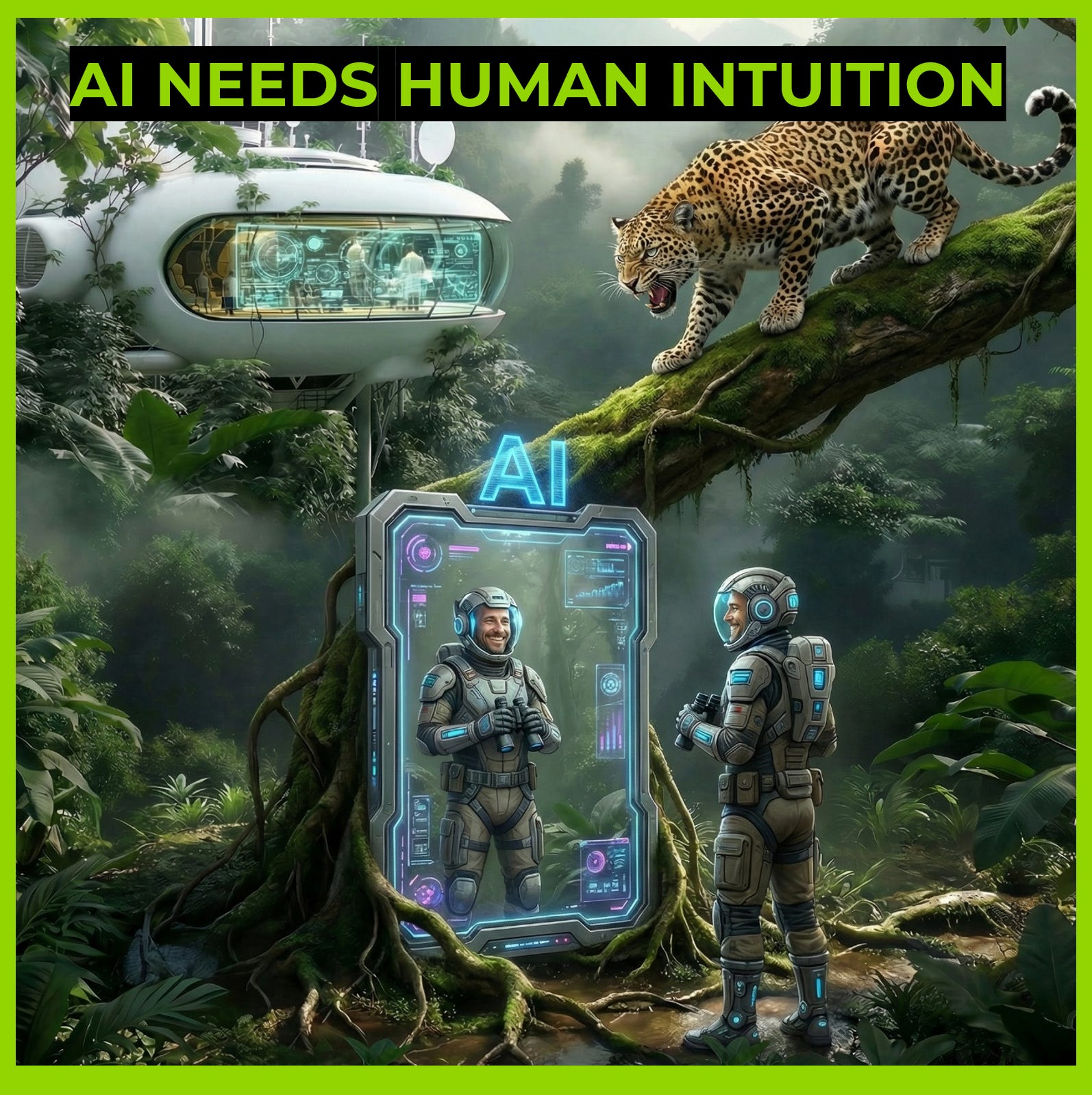
AI is already indispensable today from white collar work.
It is trained with language data. Language as a product and a mirror of the prefrontal cortex output: AI trained on text reflects the conscious, rationalized layer of human thought. It can detect patterns, correlations, and associations across billions of words, far beyond human reach. Because language encodes not only explicit knowledge but also hidden human biases induced by intuition, AI can surface parts of our implicit collective thinking — stereotypes, habits, cultural shortcuts.
What are the limits of AI?
Human intuition is fueled by embodied signals — hormones, emotions, and subtle perceptions - that never reach language. AI has no body, no feelings, no gut. It just works with output of human consciousness. You may see results of intuitive processes in the conscious output, but you can not trace it back.
In data science this is called the “confounder problem” or “model drift problem”. If you do not have information about the background confounders, you may spot correlations and predict results. But once the confounder changes, all this is obsolete and wrong. This also means that many of the associations that LLMs may learn are not causal. They simply may have a similar confounding cause, but if you manipulate one item, the other will not move.
Intuition by an unimaginably large “context window”. This includes:
1. Memory: In the brain all brain regions are literately connected with all others. This means each intuition is moderated by the entire history of a human. The hypocampus (the memory of the brain) has about 40 million neurons. Depending on the context some tens of thousands to millions of neurons can be relevant in confounding the intuitive judgment.
2. Perception: A general number in literature states that we process 40 million bits of perceptive information. Actually its much more because this is just vision, hearing, smell and touch. But we have much more than 5 senses. Actually, science has found 34 senses.
Beyond sight, hearing, smell, taste, and touch, we detect pressure, vibration, temperature, pain, itch, and pleasurable touch. Inside the body, we sense hunger, thirst, fullness, nausea, heartbeat, breathing, and bladder signals. Balance and movement rely on the vestibular system, proprioception, kinesthesia, and joint and muscle awareness. We also respond to chemical irritants, possibly pheromones and magnetic fields, and even have a sense of time. Altogether, these 30+ senses give us a rich, multi-layered experience of the world and our bodies.
Why is it important? If you -for instance never felt “love” you can not size it and make meaningful decisions about everything that relates to love. Experiencing love or any other experience is a multidimensional dynamic pattern of those 34+ senses, that AI has no clue about as it is mostly unconscious and not representable into language.
The meaning of things evolves in the experience. AI does not have experience. Just documented experience.
AI models what co-occurs in text, not “what truly causes what” in the real world. It cannot distinguish “noise” from “signal” without human judgment or the setting of the appropriate analysis context.
No escape from its training data: If some real word aspects has never been written, spoken, or measured, AI cannot infer it. It is blind to the “white spaces” of human experience. It can interpolate things across multiple dimensions that feels like inventions but broader out of the box conclusions are not part of the concept of AI. Until recently you could not find an image-AI that paint watches with showing different meaningful time. All training data is 10 past 10 or 10 to 2.
Those limits might be broadened by future inventions. But two facts make it likely that we may wait decades or even centuries:
1. We don’t know how the brain exactly works: Despite the progress we make in neuroscience, we need to admit we are just scratching the surface. We know roughly “which processor” does what – but not how. We not even sure the “processor” is the source of thinking (meaning: that there is a lot of scientific evidence that makes it not unlikely that not matter causes the brain behavior but some kind of general “consciousness” is causing the brain to . In other words: Spirit moves matter, not matter (brain) moves thoughts). How can you rebuild something you do not even understand?
2. Any prediction about the future that involves an invention, that still needs to be made, is impossible to predict. In 1958 Frank Rosenblatt predicted that AI will autonomously build robots and fly to the Mars, translate languages and so on. Translating languages needed 50 years – he predicted 4 years. The history is full of those overconfidence.
What does it all mean to us?
There is a limit in replacing humans. For many applications the failure of AI might be worth accepting. This makes it impossible to answer a question like “Are humans irreplaceable?”. It depends.
Nevertheless, what we CAN do to improve Marketing, is better reading what happens subconsciously in customers’ mind. That is what we do with Supra’s research framework combining qualitative and quantitative measurement of intuition and deriving implicit processes with Causal AI.
AI can expose our collective shadows, but only humans can decide whether to reproduce or break them.
True innovation requires stepping outside the map, not just drawing it with more detail. AI can guide, but only humans dare to risk reputation, resources, or legacy on an intuition.
AI is a mirror of our conscious knowledge and coded biases. But intuition is the compass that points us beyond the mirror - into the unknown where real progress lives.
AI can create great insights. But only if you ask the right questions.
You may only ask the right questions,
if deep inside,
you can already sense the truth.