

CREATING GROWTH
The Demand Architecture Framework

There are two paths to growth.
#1 – BETTER: Align your offer to demand, unlock hidden demand through communication,
and price appropriately.
#2 – CHEAPER: Reduce the costs of producing the offer (COGS) or of marketing it (overheads). With a higher margin, you can generate growth by lowering prices (only a good idea if competitors cannot match you) or by investing the additional profit into #1.
This means: unless you hold an unmatchable cost position, growth will come through better marketing.
Where the impact really sits
Marketing, however, is an increasingly complex field with many possible fields of action. The Growth Drivers Map below shows some important fields of action — though by no means all. Some domains drive faster returns; others drive higher impact. When creating growth, we should prioritize high-impact topics first.
The sobering realization: most topics will rarely create growth — at best, they fill a leaking bucket. Most brands tinker with marketing mix models, digital marketing, and fuzzy segmentation and targeting. All of this may be useful. But it will not be enough to create significant growth. Name one brand that grew just because of great marketing modeling!
Three topics typically show the largest yields:
· Pricing. There is a complex trade-off between the margin gained by raising prices and
the volume lost as a result. Managing it requires transparency about the price-demand curve. Most brands lack that transparency — and rarely have it across SKUs. Optimizing it has large, immediate impact.
· Creative strategy. Just 5% of ads achieve an ROI of 5–10x, compared with a mean of 2x.
That is neither luck nor creative genius — nor an optimization task. It requires transparency about the key strategic levers of creative impact.
· Category choice. Some product categories ride a long-term rising trend. Positioning on
them creates a rising tide that brands can surf.
To create growth beyond that, a company needs to innovate. Product optimizations or new features will mostly not be enough. You need radical innovation.
“Most brands waste their scarce resources on fine-tuning.”
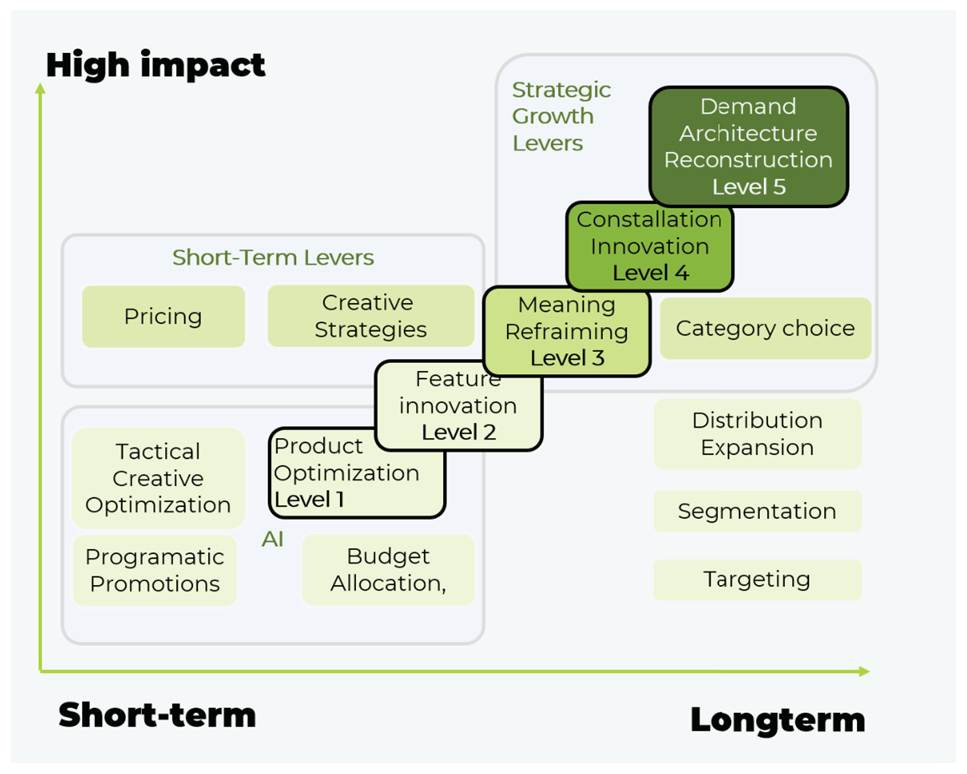
Figure 1: The Growth Drivers Map — short-term vs. long-term levers, and the fi ve levels of growth.
Consider the orders of magnitude:
· A marketing-mix-modeling exercise may increase impact by 50% — that is substantial. An
evidence-based creative strategy can multiply your impact five to ten times.
· Segmentation may help you tune in to groups. The right choice of a growing category
floods in growth on autopilot, year after year.
· Tweaking your performance-marketing playbook may halve your CAC for a few weeks —
before it bounces back. A proper pricing strategy, in some cases, doubles profits — within weeks.
The same is true for innovation: it is comforting, and easier, to optimize existing products and add innovative features, flavors, and packaging. But true growth comes when we dare to architect demand — based on a simple and solid understanding of customers’ unconscious goals and the contexts in which those goals become active.
But why don’t we have this understanding already?
“A hidden, unreflected belief may limit your growth.”
Brands do market research and have people in the field. Shouldn’t they know?
Marketing operates on assumptions that are rarely questioned: that customers decide consciously that awareness drives choice, that rational evaluation explains behavior.
It doesn’t.
Data may reveal patterns, but it cannot explain them. People do not make decisions the way they later describe them in surveys — and that is exactly what most marketing insight is built on.
What marketing teams need to start with is what actually happens in the mind before someone buys: the implicit, subconscious processes that drive behavior long before conscious thought catches up — what Daniel Kahneman called System 1. The states of System 1 can be understood through implicit research; its processes, by modeling cause and effect — not the convenient correlations that are easy to grasp but fundamentally wrong. It is not enough to read textbooks with general laws of brand growth. Each brand needs to unearth its own growth laws.
Because few brands master this art, they will not be able to grow — except by lucky punches.
The Demand Architecture Framework
It seems mystical when brands grow strongly. “How did they come up with this brilliant new idea?” is what everyone silently asks.
Successful growth strategies typically look elegant and simple — like a product from Apple. But inside Apple’s products, and inside the process that creates elegant, simple strategies, you find deep science. Master the science instead of waiting for an elegant idea to magically appear. The Demand Architecture Framework gives that process structure.
Step 1 – Deep Insights
Find the implicit goal people really want to achieve. That is not what consumers say in surveys; it takes an implicit research approach. It also involves examining current solutions to see where they force bad compromises, friction, or identity conflicts.
Step 2 – Offer Construction
Here, an offer can advance through five levels:
· Level 1 – Optimization. Only improves one part of the existing system, gradually. Product,
pricing, messaging, and so on mostly stay unchanged. Example: a slightly better taste, a packaging refresh.
· Level 2 – Functional Innovation. The system improves functional goal achievement; the
product is central. Example: a faster app, better battery, cleaner UX.
· Level 3 – Meaning Reframing Innovation. The system gives the same product a new
psychological meaning or usage permission. Packaging, messaging, pricing, and context become critical. Example: Coke Mini — “a small treat without guilt.”
· Level 4 – Constellation Innovation. Multiple system elements work together to solve
several implicit goals simultaneously. Product, identity, rituals, community, and signaling reinforce each other. Example: Gymshark — apparel + creators + community + identity culture.
· Level 5 – Demand Architecture Reconfiguration. The entire system reorganizes
behavior and demand itself. The product becomes a platform or behavioral infrastructure integrating many goals and routines. Examples: iPhone, Uber, Spotify.
“Brands spend most of their time on marginal innovations —
fine to prevent decline, not to generate growth.”
Uber’s obvious entry point was “it’s cheaper” — and it could be cheaper because the cab market is, in most places in the world, an oligopoly. But Uber achieved a shift in consumer behavior because it served so many unvoiced needs that ordinary cabs do not fulfill: What will the ride actually cost? When will the cab actually be here? Is it on its way? Can I trust the driver? Will the driver know the way without my explaining it? Will I speak the driver’s language? Can I pay easily by credit card? Can I get an electronic receipt? And so on.
The foundation is a deep understanding of consumers’ subconscious needs and desires. Once you have that clarity, a new Demand Architecture can be built.
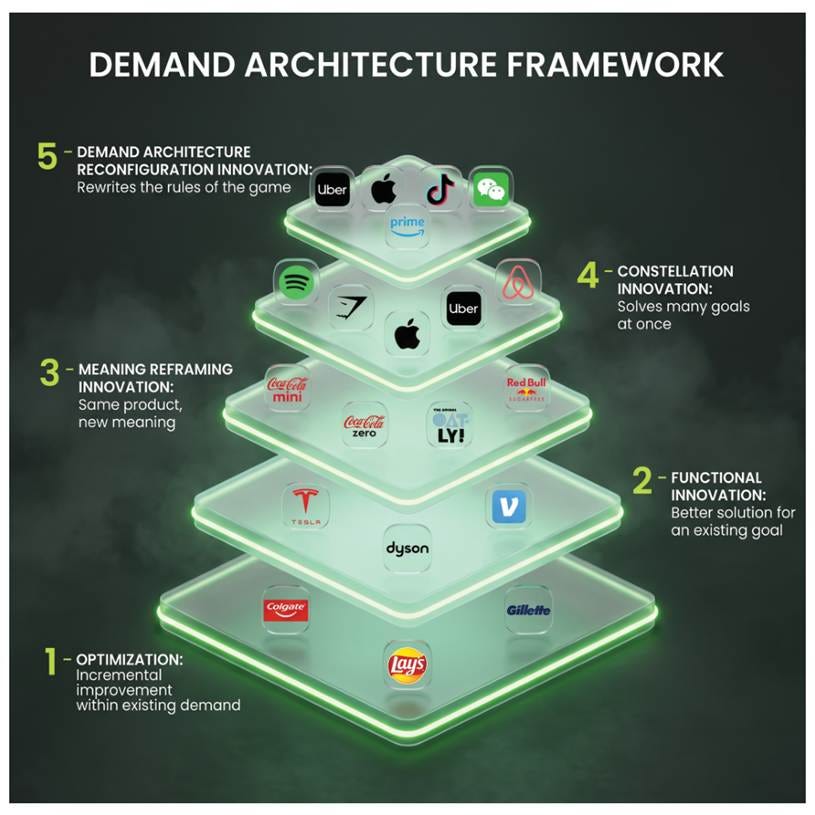
Case: T-Mobile USA
“Even as an underdog in a commoditized industry,
unprecedented growth is possible.”
T-Mobile US has grown sustainably since 2013 — in a commoditized industry. How?
In 2012/2013, the brand identified two dominant implicit customer goals: the need for coverage, and the desire to be free from dominant providers that overuse their market power. In our work on this case, Causal AI methods were used to vet these insights carefully — separating real demand drivers from plausible myths. With that clarity, execution was straightforward.
The brand invested heavily in coverage; within one year it was competitive in most US cities, and across the nation a year later. It eliminated contract terms, introduced attractive plan packages, and wrapped all of it in a Robin-Hood-style communication campaign: the Un-carrier movement. It resonated because it aligned with a powerful demand driver that competitors underestimated — people want agency and will oppose brands that overuse their market power.
Walked through the five levels, T-Mobile’s path looks like this:
· Optimization: improving coverage is, technically, an optimization.
· Functional Innovation: features such as free global roaming.
· Meaning Reframing Innovation: reframing the category from “mobile contracts” to
“freedom from carrier control.”
· Constellation Innovation: the Un-carrier ecosystem, combining network, pricing, policies,
communication, and identity.
· Demand Architecture Reconfiguration: a possible next stage — becoming telecommunication infrastructure and introducing the choice of carriers, just as roaming does. “We freed you from contracts. Now we free you from carriers.”
It does not take great inventions to create growth. It takes understanding deeper needs in their context — and building a meaningful offer that serves those needs.
The Demand Architecture Framework, summarized
The evidence from top-performing brands teaches us that what holds brands back from sustainable growth is:
· a lack of the right focus in marketing — doing everything “okay” instead of the few things
that matter most;
· the acceptance of a mediocre understanding of why people buy.
Consider how creative strategy is usually run: most brands hire an agency to build a creative strategy, then produce creative assets that are tested — at best — when it is too late for major overhauls. The process does not even allow the creative strategy itself to be rebuilt if it underperforms — the precondition for assets that perform in the top 5%. The process is broken because it is guided by opinion and rational insight, not by sound research.
The Demand Architecture Framework rests on two new perspectives. First, it focuses on subconscious goals, needs, and jobs-to-be-done — without limiting them to a category view. This requires insight methods that unearth these fundamental drivers reliably; this is not conventional market research. Second, it uses those key drivers to architect holistic, meaningful concepts in a creative process — as opposed to mindlessly stacking features. This requires understanding the customer’s context and situation.
“Growth requires a certain mindset: excellence before ‘proven’,
truth before consensus.”
The Top 5% Test
Before you put this chapter aside, ask your leadership team:
· What is the primary driver of customer choice in our category?
· What is the biggest barrier to adoption?
· What evidence supports those answers?
· Which assumption — if proven false — would damage our strategy most?
· Which describes our model of customer choice: (A) first create awareness, then convince
prospects — or (B) true needs, desires, and decisions are genuinely subconscious, beneath awareness?
“Clear gaps — and overconfidence — both signal the need for
revision.”
After answering: do you feel your marketing is fueled by clarity — or are you sensing the need for an outside perspective? Either way, the assumptions deserve a test.