

DEEP IMPLICIT
Revolutionizing Marketing Insights. Complementing AI with Deep Science of Intuition

I am working on a new book. Here on Substack, I like to share with you the chapters as I am writing them.
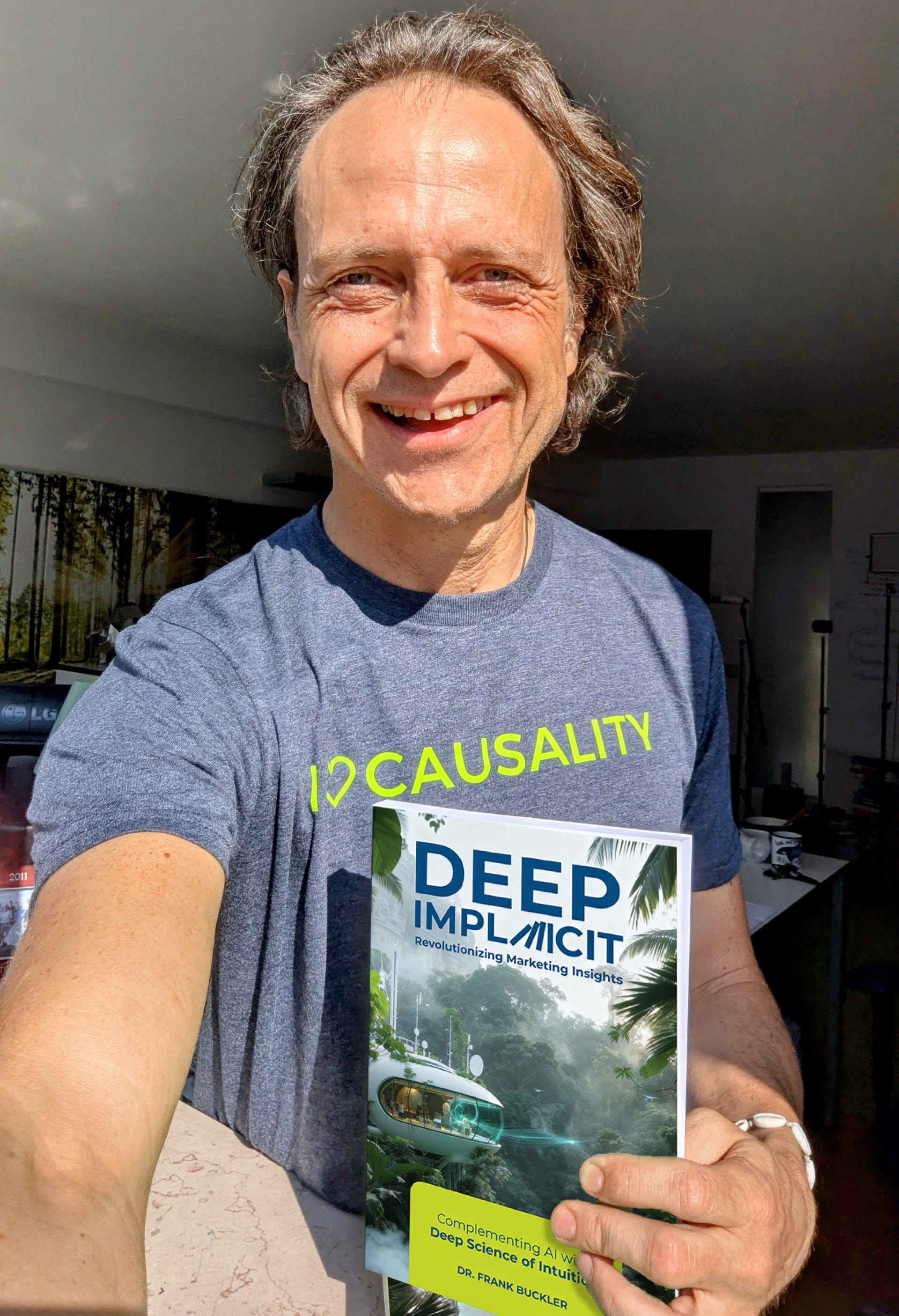
Here is why this could be interesting to you:
Why did T-Mobile won and AT&T lose? Why did Nokia lose, and Apple won? Why did NVIDIA outperformed Intel so well?
What most of us learn over time is that it is important to build a solid growth strategy before diving into the tactics of marketing. Without, you are a leaf in the wind.
Crafting a solid strategy is easier said than done. Common belief assumes it is built by gathering intellect and engaging in great analysis.
While intellect and analysis are certainly helpful, a powerful strategy builds on great insights into why and how customers buy.
Without that: Garbage in, garbage out.
Today customer insights (formerly known as market research) do not provide this clarity because it sits on an outdated model of the consumers. In its still occupied by the hundred years old mantra “Attention-Interest-Desire-Action”, which neuroscience have been proving wrong for long.
AI doesn’t help. AI can to execute the same task much fast and helps to reduce costs of data collections. Of cause it also helps to reduce errors in manual work.
But this alone does not create growth. It lowers entry barriers of good customer insights. Professional market research was mainly commissioned by enterprises. SMBs just use it occasionally at best. With AI now Enterprises lose this scale advantage as everyone can access standard market research methodology.
What brands need are not just faster and cheaper but better insights.
How do we get there? This book provides an answer.
The key to better insights is a deeper access to subconscious processes that determine why customers buy. In this book I am introducing a new research framework DEEP IMPLICIT which complements new technologies to reveal a more profound view in why customers buy.
This new research framework builds on some fundamental realization that change how we think about marketing:
1. We need to expand our understanding of what is truly scientific:
Data science is not science - Data is not the destination. It’s the fog you must learn to see through. The destinations are the cause effect links, between actions and outcomes, not data itself.
Aim for Deep, not Shallow Science: Brands need to conduct its own ground truth research because Neuroscience and Behavioral Science mainly deliver countless partial “laws” (e.g. biases) that put in practice can easily fail. The reason: Their effects do not simply add up. Even worse, the “laws” are highly context dependent and at times flip. Shallow science prescribes 100 supplements; deep science prescribes a lifestyle change.
2. We need to flip our understanding about intuition:
Gut instinct is not guesswork. There is a nonconscious intelligence that is still not well understood. It is the center of customer decision making. And it’s the beginning of marketing professionals’ ability to create better marketing. Intuition is also not emotion. In fact, you can only use and measure intuition in the absence of emotions.
Intuition boosts AI: The “Deep Implicit” Framework creates insights that can’t be gained by traditional market research or advanced AI. These insights about customers’ intuition are key to leverage AI better and create impact.
3. We need to advance our understanding of how humans make buying decisions.
Awareness & attention are vanity metrics: We need to update our model how the brain works: Purchase (intention) does not require nor is it driven by brand awareness. Driving awareness is a vanity metric, while building meaningful mental traces with the brand are not. Same with attention. Attention is a function of implicit goals of consumers. To force and fake it with advertising tricks will backfire.
In this book, I will unfold all this in more detail based on latest neuroscience. I will further present a three-step framework on how to understand those unconscious drivers of buying decisions. Those three steps combine qualitative and quantitative implicit research with causal AI methods to trace what is hidden. Over the next month I will share more chapters of the book.
Growth is not born from speed, nor from scale, nor from more data. It is born from clarity. Clarity about what moves people, what touches their hearts, and why they choose one brand over another.
When we learn to use deep science of intuition, we stop drifting. We start navigating. And then – just like Apple, NVIDIA, or T-Mobile – we no longer chase the future.
We create it.
p.s. join our webinar “How to find out WHY PEOPLE BUY” with special guest and leading global voice for marketing leadership Thomas Barta.
Secure your spot here: https://www.linkedin.com/events/howtofindouthowpeoplebuy7393946724475576320/
Thanks for writing this, it clarifys a lot. Absolutely agree.
In the young years of my career, I was also given the mantra AIDA. Having read what you just shared with us, dear Frank, I have become aware of something that I experience almost every day, mostly on my computer screen: There is a visually and/or emotionally strong stimulus that attracts my attention. Less than a second later, I notice that this stimulus had the purpose of luring me into something that I find to be completely uninteresting, boring, and irrelevant. My inner response is not desire but rejection, even regret, that I allowed the stimulus to catch my attention. I feel "taken for a ride", deceived, and manipulated. When I can remember the name (e.g., brand) or logo of the deceiver, I will avoid any further contact with them.