

DEEP IMPLICIT RESEARCH
A chapter of the upcoming book "WHY BRANDS GROW"

A New Research Framework
Marketing needs a new refreshed research approach. This builds on the latest discoveries on how human intelligence works and how people make purchase decisions. This new understanding led us to a bold realization:
The intuitive mind, not the rational, is the key object for research.
Traditional research focusses on what people say, what they are conscious about. That does not lead anywhere anymore.
To really research intuition, it needs some tricks and new approaches to size the subconscious.
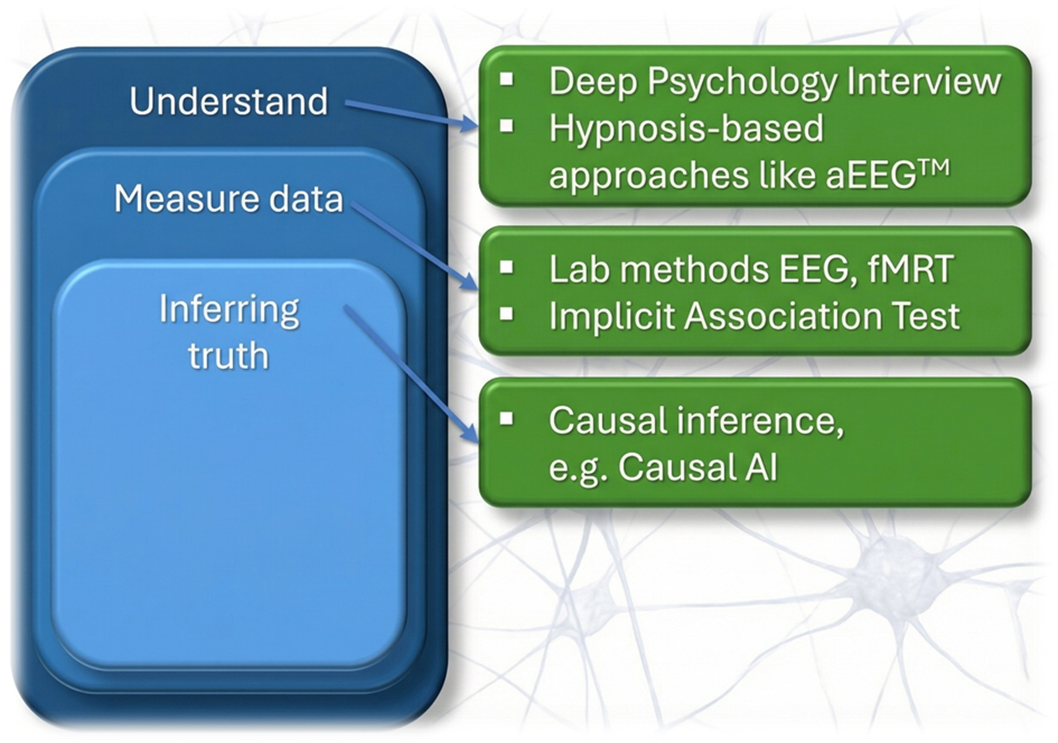
Any profound research follows three fundamental steps. First you need to understand the problem qualitatively. What’s the goal, what might be potential factors influencing this goal? Second step is to quantitatively measure the subject, collecting data about everything that may matter. Third, the data is used to infer what is causing outcomes to occur. Cause and effect cannot be measured, it is inferred.
This is the 101 of methodology of science: Frame, Measure, Infer.
Step 1 - FRAME:
What if we fail to measure important reasons for buying decisions? What if our expert judgment is not enough to size what might be relevant?
A classical method closest to our goal to size the unconscious qualitatively are deep psychology interviews. They don’t take what people say but try to infer what is driving those answers. It takes about two ours of structured interviewing to see patterns behind the stories people tell us and themselves. Conventional indepth interviews are not deep psychology interviews as they take the answers as they are. As such is AI-guided interviewing not useful either.
The limits of deep psychology interviews are that some scientific principles are violated. The outcome depends on the interviewer to hear and to interpret. It’s more an art than a science. It has value in this first step, but we need to be aware of its blind spots.
To close this blind spot we at Supra developed a new qualitative methodology that we called a-EEG (Alpha-Evoked Early Guidance). It uses techniques to lead respondents into a mental state in which they recognize intuitive ideas and are able to differentiate from follow-up thoughts. In this process we ask open-ended projective research questions and prove the value of the findings it produces. The qualitative process is now objective and scalable through this method. Beside its cost effectiveness and speed, this is the main advantage.
Step 2- MEASURE:
One methodology has been developed in the 1990s and published 1999 as the “Implicit Association Test”. Because rational thinking is slow, by measuring responds time it is able to measure what the intuitive mind believes. With this we can measure the WHAT. It collects intuitive quantitative data.
There are other methods available like EEG measuring electromagnetic signals from the neocortex, fMRI providing a more granular picture of magnetic activation in the brain. Skin conductivity and heart rate measurements are also early indicators for subconscious processes. The beauty of IAT however is that it does not require us to do lab research with expensive equipment. IAT can be run in online survey and is therefore economically viable, practical and fast. Further is measures subconscious association of any possible qualitative fact. As such it is more useful than any other method.
Step 3 – INFER:
But how can we understand WHY? How can we understand which intuitive associations make the difference and cause purchase decisions? That’s what Causal AI is made for. Causal AI is a group statistical modeling method that can explore cause-effect relationships in data (Causal). It does it in a self-learning, explorative way (AI) that does not require major assumptions like traditional statistics. Combining intuition data collected by IAT with Causal AI guided analyses reveals new powerful insights.
FRAME with a-EEGTM
The German Football Association wanted to upgrade its marketing strategy to support their women’s national team before the upcoming Euro championship. AI deep research revealed just a validation of the already existing insights and position. They were open to pilot the a-EEGTM methodology as it was promising to capture existing wisdom, fast and at limited costs.
The insights that the research revealed felt crystal clear and had been immediately implemented on social media. The first month of airing new content created an uplift of engagement metrics by 120%.
Unlike traditional surveys that rely on System 2 (slow, rational, biased),
a-EEGTM taps into System 1 - the intuitive, fast, unconscious thought processes that drive most human decisions. Instead of asking respondents directly, we guide them into a relaxed alpha brain state (around 8 Hz frequency), the state associated with creativity and spontaneous insight. Using binaural beats background sounds and an audio-guided induction, we quiet the prefrontal cortex - the location of rationalization - so intuition can surface unfiltered.
Once in this state, respondents hear a single, carefully crafted stimulus question and are instructed to write down the very first idea that arises - within 30 seconds. This simple but powerful constraint excludes rational second-guessing and narrative-building.
The analysis of the feedback happens in three AI-assisted layers:
Filtering: An LLM screens responses for intuitive vs. rational characteristics, discarding second-level reasoning. It turns out to be reliable as certain words have a strong rational association.
Synthesis: Intuitive responses are summarized into patterns and themes using an LLM
Interpretation: We probe the LLM deeper to provide structured psychological and strategic insight, surfacing underlying drivers.
Because intuition operates collectively and draws on deeply embedded heuristics, shared cultural knowledge, and embodied experiences, even 10–15 respondents can generate high-impact insights that traditional research or AI alone miss.
The power of a-EEGTM lies not in introspection but in projective intuition: asking people what feels true about the world - not what they think about themselves. This bypasses ego filters, identity defenses, and storytelling biases.
Practically, the audio tracks are produced with help of Text-to-Speech AI software. This enables us to simply change the question stimulus for each application within a few clicks.
This track is then uploaded into the YouKnow-App. A simple link is shared to participants, who then listen to the audio using their mobile phones and earplugs and lastly enter their reflections into the app.
The App can be used by anyone for free. It includes already some standard audio tracks for standard problems. Companies with a custom question reach out to SUPRA to have them take over the a-EEGTM process.
On top of this SUPRA is operating and growing a special panel of “super-hunchers”. Using a calibrated screening process, they identify in a general public panel those 5% of people who have a very strong access to their intuition. In standardized decision tasks the respondents need to “guess” the truth in 25 cases where the truth is known. Like “which ad is working”, “which price reduction” works, or “which product will win”. By accessing those talented “superhuncher” individuals, the quality of outcomes is further improved. A related effect and phenomenon is well published in the book “Super Forecaster”.
The key findings of the German Football Association using the method had further to be validated in a quantitative causal analysis. This study found that the key finding of the a-EEGTM process turned out to be -by far- most important driver to win fans among a list of 25 others. Without this qualitative phase the quantitative study would have missed the key driver as it was not mentioned by industry experts.
MEASURE with Implicit Association Test
The University of Hannover once did an interesting experiment. They altered the sport sponsorship in a racing game for each respondent player and later measured brand consideration. It turned out that most player did not been aware that they have seen the sponsorship ad. But the uplift in brand consideration was significant and relevant.
Again, awareness is not a good measure, not a good indicator and not a requirement for impact on purchase intention. Advertising mostly impacts System 1, which in large parts we are not consciously aware.
Imagine standing in front of a product you’ve never seen before. Within a heartbeat, you already feel whether the price seems right. No calculation. No comparison. Just a gut reaction. That instant “yes” or “no” is your implicit judgment — and it happens in less than a second.
This is the realm of the Implicit Association Test (IAT). Originally developed in psychology to reveal unconscious judgments and stereotypes, the IAT can also uncover how consumers truly perceive e.g. a price - before rational thought kicks in. Instead of asking people directly what they’d pay, we can let their reaction time speak. When respondents are shown a product with a price and asked to make a quick association (e.g., “appropriate” or “fair,” “risky” or “don’t want”), their speed reveals whether the price fits their internal expectation. Fast answers signal intuitive agreement. Slow answers indicate conflict, doubt or simply lack of associations.
Why does this matter? Buying decisions are always made by automatic, unconscious processes. Traditional surveys miss this entirely, because respondents rationalize, anchor on arbitrary numbers, or underreport what they would truly accept. The IAT bypasses this rational filter and measures what people know before they think.
The beauty of the IAT is that it listens to a part of the consumer that words often can’t express. It turns instinct into data.
And when you can measure what’s hidden, you can finally act on what truly drives behavior.
The applications are vast. I mentioned pricing and touchpoint modeling. We also can understand how brand, products, ads, packaging and more are perceived. And we can measure the intuitive impulse towards actions customers have.
INFER with Causal AI
Imagine a lottery company looking at its customer data. On the surface, the numbers are clear: older people buy more lottery tickets. So, the marketing team doubles down on senior audiences. That is what is happening across the industry.
But when Causal AI is applied, a different truth emerges. Age isn’t the cause - it’s a co-evolves with the time it takes to for consumers to form a habbit of playing. What actually drives sales is ritualized playing, formed over years. Older customers simply had more time to build that habit. The real growth potential lies with younger players, by helping them build habits earlier. A subtle, subconscious mechanism became visible.
This is what Causal AI does: it helps us distinguish surface patterns from underlying cause-effect mechanisms. Traditional machine learning works like a mirror - it reflects patterns in data, even if they’re accidental. Correlation is mistaken for causation, leading to marketing strategies that seem plausible but are fundamentally wrong. Causal AI, on the other hand, works like a filter. It removes noise and spurious correlations to isolate what truly drives behavior. It detects hidden causal chains - those often-subconscious forces that shape why people buy.
Technically, this means combining advanced AI algorithms with domain expertise and causal testing. Instead of simply finding a formula that “fits” past data, Causal AI discovers the structure of reality itself - which factors cause change, in which direction, and how they interact. It reveals non-linear effects and hidden interactions: like when pricing only works if visibility is high, or when loyalty programs succeed only when the product is resonant. These subtle AND-connections, rather than simple additions, shape real-world outcomes.
For marketers, this is more than a technical shift. It’s a mindset shift. It means stepping beyond the obvious, questioning what looks “plausible,” and seeking the truth beneath the surface.
And that is where Causal AI helps surface intuition processes. Implicit Association Testing reveals intuitive associations and memory structures. Causal AI finds those internal causal links that finally lead to buying decisions. This technology is the solution to reveal subconscious processes and connections that we simply can not measure. Therefore, it’s the third tool in our toolbox to better understand why people buy.
Together with this method, they turn vague hunches into actionable insights. We stop guessing what drives people - and start seeing the invisible forces that do.
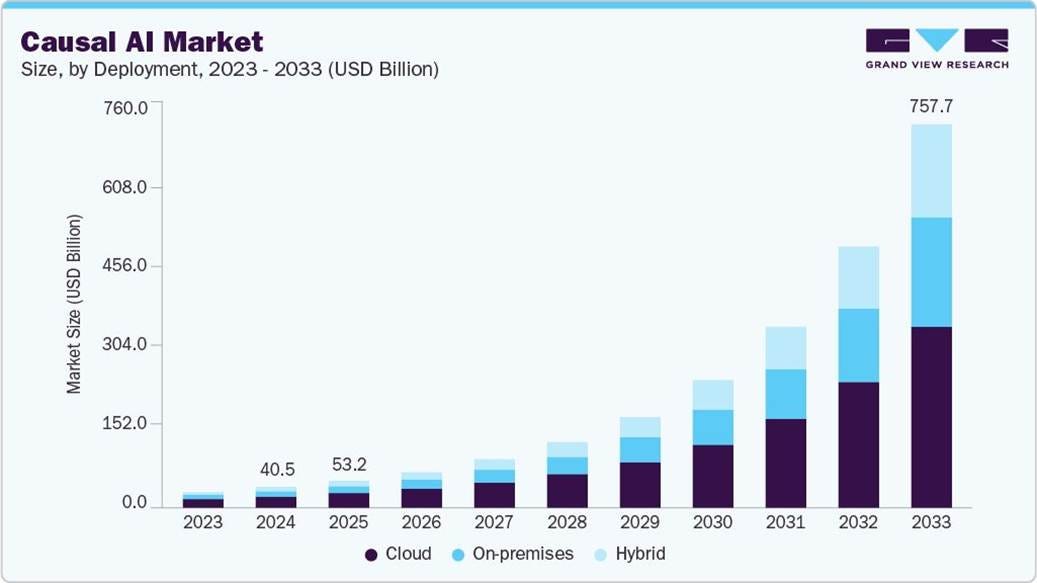
How to do it? The market of Causal AI software is growing rapidly as we speak. This graph shows the predicted market for Causal AI.
At SUPRA we develop and use our own software and optimize it for Marketing applications since over two decades now.
“Deep Implicit” Research
Marketing research needs a reset. The real driver of buying decisions isn’t what people say or think consciously — it’s intuition. That’s why the new standard should become an approach I call “Deep Implicit”. It researches intuition on three levels:
First uncover the hidden decision space qualitatively (with methods like a-EEG that surface intuitive signals instead of rational stories), then measure intuition at scale (e.g., with IAT reaction times), and finally identify what actually drives behavior using Causal AI.
The shift is simple but powerful: stop asking people what they think, start capturing what they intuitively know - and move from correlations and opinions to the real cause-effect mechanisms behind growth.
p.s. here are live formats where you can dive deeper into this
April 15, 2026 - 1-day Masterclass https://masterclass.supra.consulting
April 29, 2026 - IIeX NA in Washington DC
Feb 26/27 2026 - GOR conference, Cologne.