

How People Buy
Chapter of MARKETING, Fast and Slow


HOW PEOPLE BUY - A New Framework
The conventional way how most of us believe people buy is this
1. Attention: A product or offer comes to our awareness
2. Interest: We process all the information and may find it interesting
3. Desire: After evaluation customers build a desire in the best case
4. Action: Finally, customers need to execute this desire
This frame of thought assumes that only what comes to awareness can work. That is how we think of ourselves as a human. Because I only can be conscious about what I realize, I assume this is the prerequisite for me to decide.
“I think, therefore I am” French Philosopher Rene Descard, puts this in 1637. To date, most of us still implicitly believe this. Because we are aware of our rational mind and unaware of everything else, making us believe the rational mind is the master.
Already Albert Einstein can be quoted “The intuitive mind is a sacred gift and the rational mind is a faithful servant. We created a society that honors the servant and has forgotten the gift”
Half a century later neuroscience found that Descard’s and our shared belief that rational mind is in the driver seat is a giant illusion.
In “Thinking, Fast and Slow” Nobel Prize Winner Daniel Kanemann summarized the state of science well:
We have a rational brain that he calls System 2, which gives as the capacity to logic, rational, analysis, language and most of all: self-referenced thinking (something that some people define as consciousness. I call it differently but that’s not our topic here).
All other parts of the brain Kanemann calls System 1. These parts handle perception, instant evaluation, memory, goals, willpower, emotions, and execution.
Although Kanemanns book is well known, just a fraction of marketing professionals who know it, have read it. An even smaller fraction has actually understood it and its implications for marketing. Changing this is the very mission of my upcoming book.
To understand why customers, make certain decisions it is helpful to understand the causal processes that lead to customer decisions. It is of cause the general process of how humans make decisions which are actions.
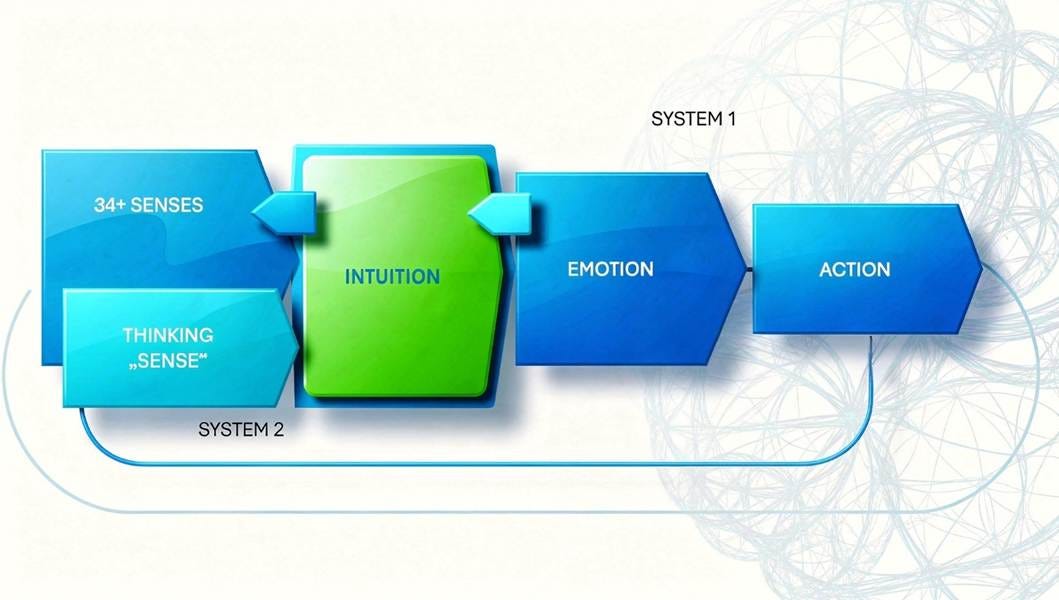
This process is a recursive process of unlimited loops. I am simplifying it as a process that starts with perception delivered by our senses:
1. SENSES: We perceive the world, products and service or advertising through our senses. We know today 34 senses and this list is not even fixed. Depending on how you calculate it this floods way more than 10 million bits of information in every second into our brain. Nearly all of this never percolates into our awareness.
2. INTUITION: The information flows into many different parts of the brain that work together to form an intuitive responds as well as to store information. This responds is qualitative and not yet judged or categorized. It can be seen as our central processor. Science and society have overlooked it yet because introspection into this processor is very hard to do. Subjective introspection takes practice and the right tools. Objective introspections are even harder and science is just scratching the surface.
3. EMOTION: Emotional parts of the brain now assess the result of intuitive thinking. That is needed to create a response. Is the situation good or bad, opportunity or thread? What are the actions to achieve subconscious goals. All this happens in milliseconds and makes decisions. Even more interesting: the flow of information is not just a funnel. Actually, control information flows backwards too: Implicit goals, that are built in the limbic system, a part of the emotional brain, are things like the want for security, adventure or excitement. Depending on which goals are active, the intuitive mind focusses on different things. Same with perception. We focus our retina on parts on the visual field that most likely serve our implicit goal.
4. THINKING: Thinking kicks in last – if any – and it takes a lot of time. It serves as a controller. Thinking is the internal revision department and it potentially creates awareness about inner processes. It is able to apply logic with the use of language. Its rational capabilities are limited and can not deal with complex tasks. Complex tasks need to be divided into simple subtasks. The result of thinking is an input to intuition again. As such thinking can be viewed as a type of sense. That is a revolutionary realization. Because until today the common belief was that thinking is not only making decisions (which is not true). Even during life, we form the belief that thinking IS us. But that’s just an illusion. You are not your thoughts. A simple truth that humans can experience in meditation in absence of thinking.
Viewing the buying process in this light has major consequences to marketing and marketing research.
In history of science, we tended to underestimate the role of intuition because we simply just had only awareness over our thinking. This made us erroneously believe that the customer is a homo economicus. Later in behavioral science we tried to fix this model by accounting for “irrational biases” that humans make. Finally, we understand that this intuitive intelligence is so vastly powerful, and we just learn peace by peace what it can do.
We understand that buying decisions are mainly (say 90%) driven by the intuition. And even high involvement buying decision who involve stage 4 “thinking” are mainly informed and guided by the outcome of stage 2 “intuition” and stage 3 “emotion”.
If this is the case, what needs to be done to explain purchase decisions?
Exactly, we need to go beyond the realm of awareness. We cannot simply survey prospects and gather information they are aware of (Step 4).
We need to research step 2 and 3 and just complement with step 4.